Behaviorists arise: a new tool from Imagini is profiling consumers using visual clues. The UK company launched its Virtual Rorschach onto the great unwashed last year and has since amassed the usual list of Big Name Marketers (Microsoft, Vodafone) who are tackling the Really Big Issues. But beneath the hype lurks a useful tool for proving that a picture really is worth a thousand words.
Today’s Journal reveals that 130,000 people have already completed a Imagini profile; MSN tested the service with 50,000 users last year.
And it is amusing. According to Imagini I share my aversion for hairy males with 29% of Imagini participants. Only 5% find someone picking their nose more gross.
Oh, apparently the site also provides a unique gift finder for the hard to buy for. Amongst its recommendations for Mrs Mortarmark was a very tasteful Ceramic Wasp Trap and the rather amusing idea of sponsoring a milk Cow (I guess you have to know Ms M to laugh at that one… or maybe not). The Gift Guide is here. Fair warning it only seems to serve the British at this time.
Here’s an idea for those of you PR doubters. Why not ask site visitors how they came to hear of your site?
A recent survey of holiday buyers on a client’s ecommerce Website revealed that nearly one third of site visitors can be attributed to PR activity. Verbatim from the email:
"Just thought you’d like to see the responses to one of the questions I slipped in the survey we ran with 4th quarter buyers:
Question: How did you first hear about XYZ.com?
And of those who answered other it was pretty much 1/3 article 1/3 website 1/3 crazy
This tells me close to 30% (article + TV+ Other) found us based on PR type activities. At least that is my interpretation…"
Careful readers will note that the site attracted 3,800 buyers, too. Want to know more, contact MortarPR here.
Consider one of the the cardinal rules of online registration: limiting options significantly improves participation rates.
Time and time again we have watched as online registration success wilts under the pressure of offering visitors numerous chances to qualify an opportunity before parting with their email address.
Imagine you are a student keen to get details on an upcoming course. Or a potential investor shopping for white papers about technology advances. Or perhaps you want to apply for a job or hook up with a mate.
You’d expect to fill out some kind of web form so you can access the data online or receive it via email.
So one would also expect visitors to welcome the chance to fully qualify the data before being completing the form. Its not hard to imagine the rational user carefully weighing their options carefully before committing to respond.
Well, you’d think so, but the reality is very different.
Our experiences over the last 10 years of online marketing suggest that the opposite is far more effective.
The more data on offer; the more links that can be clicked; the more options to explore; the less likely people will respond.
Online it seems we all have an itchy clicking finger. And we are far more willing to complete a simple form–even if it dooms us to a never-ending blizzard of spam–in return for instance gratification. Too much information induces confusion, and dithering consumers won’t commit.
We at the Mortar are not alone in coming to this conclusion.
Say what you will about the ubiquitous University of Phoenix’s (UOP) online advertising, but doubt not that they know how to lure the unsuspecting into completing a form. Every UOP ad leads to an online cul-de-sac with only one exit point: a completed form.
Online it seems freedom of choice causes rancor, confusion and gets in the way of making the bleedin’ sale.
For those of you who are puzzled by this phenomenon, and seek the insight for which the MortarBlog is prized, are urged to click through to listen to Barry Schwarz, author of the "Paradox of Choice", explaining how abundance in today’s society is actually making us miserable. Barry’s comments were recorded at the TED conference in Oxford, UK in July 2005.
For a interesting perspective on how these options came to be in the first place, click through for "Tipping Point" author Malcom Gladwell’s presentation (part of the same Ted series) on how the development of spaghetti sauce doomed US consumers to the ravages of choice.
The TED talks are highly recommended. Register for the Podcasts here.
1. Apple’s Mac meets PC. Simple concept. Clear cut art direction. Breathtaking simplicity. This is just one in the series. Click through to see more.
2. Careerbuilder.com’s Monk-e-Mailfor better ROI than the Superbowl and superb integration between the Web and your phone (click here for a sample).
3. The BackSeat Driver handbook from VW.
“Being a backseat is not a right. It’s a privilege. And a
responsibility. What you will learn from this handbook…” and so on. The
booklet is then filled with useful information including the drink to
bladder ratio at which point a driver will need to stop the car. (A
driver is only good for 30 minutes on a 32 ounce coffee, for example.)
The final pages include an exam and official plastic Backseat Driver License. This is more fun than German engineering."- MarketingBlurb. See all the pages here.
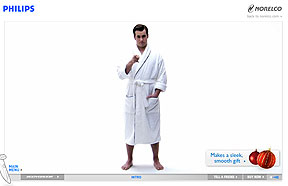
4. The Art of Shaving. "Philips knew it couldn’t hawk its unique "Bodygroom" shaver — designed
to help a man shave hair on his back, chest and intimate body areas —
on a mass medium like TV. The product wasn’t for everyone, and might
even be seen as offensive. So the company’s ad agency, Tribal DDB, went
the lighthearted route — creating a Web site starring a man wearing a
bathrobe chatting about what the shaver could do. To get the word out,
the agency alerted friends of employees…(the) public-relations firm Manning Selvage & Lee also helped drive
traffic to the site by getting the product mentioned on Howard Stern’s
program on Sirius Satellite Radio."- WSJ Suzanne Vranica, Brian Steinberg. Click here to see the site.
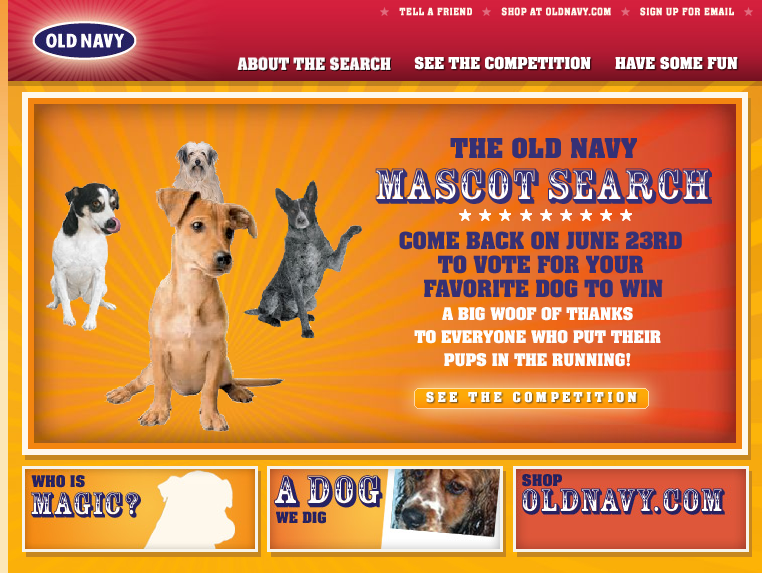
5. Paco wins Old Navy’s mascot search. The promotion (profiled on MortarBlog in June 2006) attracted hundreds of thousands of dog lovers. Old Navy announced the winner in July.
From the release:
"SAN FRANCISCO – July 26, 2006 – Paco has that Old Navy magic! Old Navy is thrilled to announce the winner of the brand’s nationwide search for a new canine “spokesdog.” America has chosen Paco − the fun-loving, free-spirited dog from Venice Beach, CA − to be Old Navy’s new mascot, Magic. Paco edged out the five other finalists to claim the title and will replace the much-loved mutt Magic who appeared in the company’s advertisements in the late nineties. The new Magic will go on to star in upcoming Old Navy advertising and, like the original, become part of the brand’s history…
From April 24 through May 29, 2006, the search for the new Magic was open to dog owners throughout the U.S. and Canada. Contestants submitted their dog’s photo and personality profile online or by attending one of four casting call events held throughout the month of May. Thousands turned up at the events to get their photos snapped and to enjoy dog treats and activities. In addition, Old Navy made a series of financial donations to local animal charities in each city of the Canine Casting Call tour to help animals in those communities.
A panel of celebrity judges – including Katherine Heigl (“Grey’s Anatomy”), Alfre Woodard (“Desperate Housewives”), Malcolm David Kelley (“Lost”), Kristin Chenoweth (“RV” and “The West Wing”), Betty White (“Golden Girls”), and celebrity dog trainer Andrea Arden – selected the finalists from more than 120,000 entries based upon appearance and personality from each dog’s online profile.
Magic first appeared in an Old Navy back-to-school campaign in July 1995. He went on to star in more than 60 ads, becoming an icon for the brand. Magic co-starred with the late style icon Carrie Donovan as well as actors and personalities including Morgan Fairchild, Ivana Trump and Liz Smith. His last appearance was in the Spring of 2001. "
The wrapping paper is on it’s way to the recycling center, the tree has been de-ornamented and sits forlornly in front of the house, still strung with lights so cheap we will just buy new ones next year.
Santa (a.k.a. Mom & Dad, 2 sets of grandparents, and a few Aunts & Uncles too) was WAY too good to my daughter; this Christmas was "all princess, all the time." There were no less than 5 costume changes on Christmas morning. And the seven fluffy gowns with matching tiaras will be in heavy rotation in her dress-up repertoire for months to come.
And what to my wondering eyes should appear, but a super New York Times article on the whole "Princess Craze" that is sweeping the planet. Here is a snippet:
"To call princesses a “trend” among girls is like calling Harry Potter a
book. Sales at Disney Consumer Products, which started the craze six
years ago by packaging nine of its female characters under one royal
rubric, have shot up to $3 billion, globally, this year, from $300
million in 2001. There are now more than 25,000 Disney Princess items.
“Princess,” as some Disney execs call it, is not only the
fastest-growing brand the company has ever created; they say it is on
its way to becoming the largest girls’ franchise on the planet."
My personal favorite from the article is: "To ensure the sanctity of what Mooney called their individual
“mythologies,” the princesses never make eye contact when they’re
grouped: each stares off in a slightly different direction as if
unaware of the others’ presence."
What, if Cinderella and Aurora look each other in the eye they will spontaneously combust or something? Strange and interesting… and so Disney.