St. Mary’s emergency room at Stanyan and Fulton in San Francisco is one of the quickest in the West.
Which is important as the average wait in a urban ER can be up to 4 hours. Ouch.
See more here.
 Here’s the full release:
EMERGENCY ROOM CARE IN UNDER 30 MINUTES?
Mortar’s New Campaign for St. Mary’s QuickCare is No Joke
San Francisco, CA (September 30, 2006) — This month, St. Mary’s Medical Center—one of San Francisco’s leading hospitals—unveils a new outdoor ad campaign for its QuickCare ER service, designed by integrated agency, Mortar.
With average wait times of up to four hours, it’s no wonder that most emergency rooms get a bad rap. Not so at St. Mary’s, where QuickCare staff promise that ER patients with non-life-threatening illnesses and injuries will be seen in under 30 minutes.
With a highly trained team of doctors and nurses, St. Mary’s offers quality, reliable ER care around the clock. Its unique QuickCare program—with 24/7 triage, bedside registration, and faster x-rays—features a streamlined evaluation process to make sure patients won’t spend hours waiting in the emergency room.
“Modern healthcare is changing. At St. Mary’s, it’s about putting patients first, and that means caring for people quickly,” said Ken Steele, CEO, St. Mary’s. “St. Mary’s is the pioneer of fast emergency room care in the Bay Area—we are the place to go if you want immediate, skilled care so that you can get on with your life.”
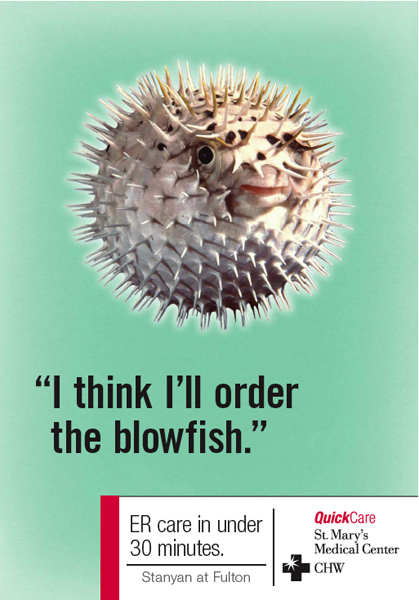
A departure from typical healthcare advertising, Mortar’s campaign for St. Mary’s takes a gently humorous approach to the everyday situations that send people to the emergency room. Whether they are hurt crossing the street or fall ill after eating something adventurous, San Franciscans can start down the road to recovery within 30 minutes of arriving at St. Mary’s QuickCare. Intended to deliver a local, San Francisco feel, the ads can be seen around the city on buses, bus shelters, Mushroom_busqueen and banners.
“Humor is rarely used in healthcare, and we wanted to develop a campaign that is refreshing, new and above all approachable,” said Tim Spry, Creative Director at Mortar. “Accidents are a reality of life—no one likes going to the emergency room. By taking a light-hearted approach, this campaign says that if you need to go—even for minor injuries—St. Mary’s will have you in and out of there in no time.”
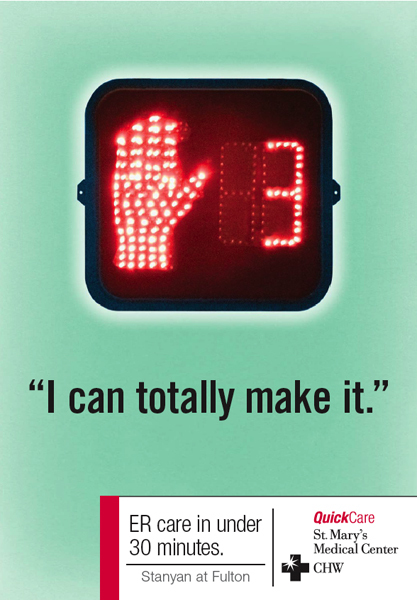 Every day in San Francisco, nearly 10 people are injured in traffic collisions—incredibly 1 in 6 of traffic-related injuries are caused by people violating traffic signals.* That’s why one ad, headlined “I can totally make it,” features a close-up of a pedestrian walk light flashing “3 seconds”.
Upset tummies often warrant a visit to the ER too: food poisoning affects 200,000 Americans every day.** And as one of the world’s culinary epicenters, San Francisco is home to plenty of daring diners. So the campaign also reminds viewers that it’s OK to visit the ER if you are feeling queasy.
To view examples from this campaign, visit mortaragency.com/stmarys
About St. Mary’s Medical Center Emergency Room / QuickCare
People can’t always avoid life’s minor accidents and illnesses. But St. Mary’s QuickCare program helps patients avoid spending hours waiting in an emergency room. This unique program guarantees that patients will be seen within 30 minutes of their arrival. The QuickCare program is available to patients with non-life-threatening illnesses and injuries. The program offers 24/7 triage, bedside registration, plus faster X-ray results and a smooth, more efficient process.
For nearly 150 years, St. Mary’s Medical Center has provided the Bay Area with compassionate, personalized care combined with the latest advances in medical care and cutting-edge technology. One of San Francisco’s leading hospitals, St. Mary’s offers patients a full range of outpatient and inpatient services delivered with the human touch. St. Mary’s QuickCare is located on the corner of Stanyan and Fulton in San Francisco. For more information, visit www.stmarysmedicalcenter.org
or call 415.750.5700.
About Mortar
Mortar is a new, San Francisco-based brand communications agency dedicated to helping organizations make emotional connections with today’s shell-shocked consumers. Mortar’s unorthodox approach typically combines street-level research, integrated strategy, online and offline advertising, public relations, and immersive tactics that defy boundaries and amplify budgets. Details at: www.mortaragency.com
*According to the San Francisco 2005 Collision Report by the San Francisco Department of Parking & Traffic, non-fatal injury collision totals for 2005 were 3,227. 16% of these were caused by violation of traffic signals and signs.
**The Centers for Disease Control reports that an estimated 76 million cases of foodborne disease occur each year in the United States.