Author Archives: MortarMark
June 18th, 2006

Get out of the dark

Img_0112
Img_0115The message "Get out of the dark" for the San Francisco Examiner newspaper is only visible at an oblique angle on this clever bus shelter.

This ad is part of an outdoor series that relies on unqiue placement to remind viewers that insight is available on their doorstep every morning. The campaign is all the smarter, as the Examiner is most often seen sitting waiting, polybagged on the sidewalk just like this bus shelter.

The opinions expressed in  Mortablog  are not necessarily those of the author or anyone else at the Mortar
for that matter.  Just who owns them is kind of unclear really.  If you
do find someone who will own up to them for sure, let us know.

June 18th, 2006

The Almighty Linden.

Businessweek
I just heard of a geezer who made $250,000 selling virtual real estate.

Cue Second Life, from Linden Labs.

Overlook for a moment the benevolent but kinda scary meglomaniac founder Michael Linden. He gave his name to the company, the currency (Lindens), the economy and gives frequent speeches about the state of things virtually just as Al and Ben comment on the economy in the real world.

Focus instead on the fact that hundreds of thousands of dollars in real money has exchanged hands between the members of  this uber-Sims community, and that Second Life has already spawned the world’s first (real) lawsuit over virtual property.

Which means we are now at the point in life where we are forced to differentiate between what is real and virtual; we have arrived at the  moment foreshadowed by Bladerunner. In the movie, Deckard has a hard time telling the difference between artifical life and the real thing.

In deciding between Linden and the Plaintiff, who reportedly hacked a Second Life auction for sim (the name for artifical land in Second Life), a court in New Jersey has to grapple with the same collison of realities.

Let’s not trivialize the grandeur of Linden’s Second Life dream. They have created a parallel world with sophisticated laws, a functioning economy and active members. Taking their cue from Moses and the Big Guy Linden has made key decisions about society like how large your head can be, whether you have to listen to your neighbor’s tunes, and how, exactly, you should go about matching buyers and sellers of virtual property.  And they are living with those decisions every day. 

They are the first self-appointed Gods of the ether.

But unlike the Lord they have to answer the phone and remain accountable to their flock (that has to suck).

Remember all those people who made millions selling domain names while the rest of us searched for the Next Big Start Up? And how eBay made millions selling other’s crap? Or how the Star Registry will name a piece of the Cosmos after your cat, Tiddles?

Well, Linden are selling an experience. They have created a thriving market out of the ether. And a chance to start over. Business Week calls the whole thing "seriously weird", but underscores the funadmentals of Linden Land by pointing out that Linden have attracted investment from Amazon’s Jeff Bezos and another $11 million in venture money.

I recommend you pile in.

Oh, those of you interested in the latest trend in online identity verification, check out Linden’s offer of  a one-time gift of 25 free Lindens to new users who validate themselves via credit card.

Its nice to know the new world is just like Vegas.

Viralists will note they also offer L250 for referrals.

I signed up today. Look for my Avatar: Mortarmark Gremminger.

I’m thinking of starting the First Linden Church: want in?

The opinions expressed in  Mortablog  are not necessarily those of the author or anyone else at the Mortar
for that matter.  Just who owns them is kind of unclear really.  If you
do find someone who will own up to them for sure, let us know.

June 15th, 2006

Down Goes Dignity! Down Goes Dignity! Down Goes Dignity!

Picture_7

Dads! Ever get that not-quite-fully-emasculated feeling? Worried that you might have a small shred of dignity left?

Then strap on your kneepads and saddle – er, Daddle up! No, we’re not kidding. Yes, we wish we were.

June 15th, 2006

99 of the Fortune 100 will not read this blog.

A VMware sponsorship message on KQED got me thinking this morning.

More than an elevator speech, radio sponsorship messages are the epitome of corporate brevity: to succeed you must encapsulate your entire reason for being in 30 words or less.

VMware’s message included this phrase:

"This message is brought to you by VMware. 99 of the Fortune 100 use Vmware. Go to VMware dot com for more details"

Now I wonder if the marketeer who crafted that message was thinking of Moore’s Chasm theory?

Moore’s work on the technology adoption cycle is as fresh today as it was back when it debuted in 1991 (before the Web, before iPods, before Dell, back when Casio and Digital Equipment were big tech brands and we were friends with Saddam and Osama).

We recently dug into "Crossing the Chasm" for some work in the tech sector and were astonished by the richness and depth of Moore’s analysis.

At the core of his work is the idea of a gap between early adopters and the rest of the market.
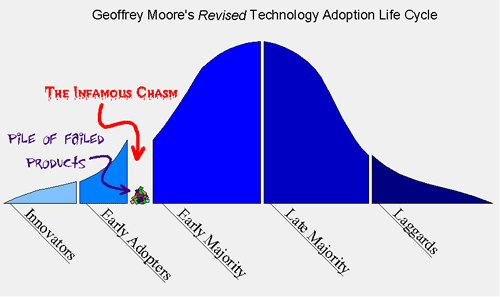
Galloway1_2

Early adopters actively cherish breakthrough ideas and latch onto new technology because it is innovative and exciting. They buy promises and seek first mover advantage.

On the other side of Moore’s chasm swells the much larger mass market, and the decidedly less innovative, go-with-the-flow, don’t-stick-your-neck-out, Sure,  I’ll-buy before-anyone-else but I’ll-need-some-references-first  segment which he identifies as "pragmatist":

Throughout the 1980s, the early majority, or pragmatists, have represented the bulk of the market volume for any technology product. You can succeed with the visionaries, and you can thereby get a reputation for being a high flyer with a hot product, but that is not ultimately where the dollars are. Instead, those funds are in the hands of more prudent souls, who do not want to be pioneers ("Pioneers are people with arrows in their backs"), who never volunteer to be an early test site, ("Let somebody else debug your product") and who have learned the hard way that the leading edge of technology is all too often the "bleeding edge".

By citing their credentials with the F100 VMware are solidly positioning themselves for success with pragmatists.

But, warns Moore, you only have one chance to impress visionaries. The adoption cycle runs from left to right, from early adopter to mass market, not vice versa.

And there is no backing up to the visionary segment once your product has crossed the chasm into the mainstream.

Now I don’t know VMware very well. And what I do know about virtualization technology could be pressed onto a gnat’s eyebrow (and still leave room for something meaningful).

They may well be the pragmatists choice.

But somehow I wonder if VMware wasn’t instead overly influenced by its larger and dominant parent, EMC (which is firmly and irrevocably a mainstream storage company) and rushed into this statement becuase they couldn’t think of anytjing more original to say.

It seems you can pack a lot into 30 words, afterall.

The opinions expressed in  Mortablog  are not necessarily those of the author or anyone else at the Mortar
for that matter.  Just who owns them is kind of unclear really.  If you
do find someone who will own up to them for sure, let us know.

June 14th, 2006

Pandora’s Squeezebox

Fans of Internet radio rejoice. Pandora, from the Music Genome Project, has arrived.

File under "how did I ever live without this". Pandora is the online music station for your inner DJ.  Simply enter the bands or artists you like and it’ll stream similar songs to you all day long. Unlike iTunes and other web radio services, Pandora provides a more interactive experience — its kind of like Amazon’s "if you liked this book, you’ll love these" service.

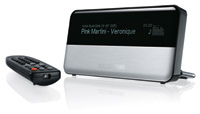
Sb3_hero_200
Like that? You’ll love this. 

Squeezebox is a $250 gizmo that streams web radio (like its partner Pandora and the now positively venerable iTunes) wirelessly through your stereo.

But perhaps most interesting is the business partnership between these two.

Pandora is subscription based. You get to listen for so long, or to so many songs before paying a small fee. Seems like a fair deal to me. I get to test out the service first. Establish whether it fills a gap in my life (it does) and pay accordingly.

And to help me with my listening enjoyment, Pandora offers me Squeezebox so I can rock out away from my Mac.

Pandora no doubt gets a spiv from Pandora in the form of a revenue share on Squeezebox sales.

Another perfect example of an web symbiosis. Just like Orbitz crossing selling hotels and vacation packages to complement travel plans, and eBay offering bonds to guarantee online purchases.

Note from the Viral Monitor: Pandora made its debut here at Mortar about five weeks ago in an email from an account services colleague. And the first Squeezebox was delivered to one of the CDs two weeks ago.

I’m going to be putting in my order soon.