 Combined the Mortar gang has three quarters of a century of experience in advertising and I am proud to report we are still not happy with our briefs.
In the hope that the Truth Really Is Out There, here are ten thoughts on giving good brief:
What is a Creative Brief?
Simply put, the written instructions to creative. Typically developed after research into a marketing problem the brief marks the transition from the account team to creative.
Be warned, many people (particularly Creative Directors) believe there is no such thing as a Great Brief. Take Jeremy Diamond at Ogilvy:
“Everyone remembers [Michelangelo’s Sistine Chapel] but no one remembers the brief. No one ever built a great brand by writing great briefs. The truth is that there is no such thing a great brief-only a brief which leads to a great creative idea”.
To a degree, Jerry has a point. As hard as it is to squeeze all that is known about a job into 350 words or less, the brief represents the jumping off point for the creative process, it’s something to be good at. What really matters is the end result.
Yet, a communications environment defined by consumers who are no longer loyal to a handful of media (were they ever?) demands a creative process that starts from a more fundamental point. For us, at Mortar, it has caused a general elevation of the briefing process into something much more critical and rigorous.
That’s enough waffle. On to THE DEEP THOUGHTS:
1. Briefs are Intellectual Property. They are secret. Wise corporations don’t let anyone see their briefs. No wonder Agencies rarely publish them. After great work, effective briefs are the most important, if least discussed, part of our craft. In contrast to discussions about the end result, tantalizingly little is available online or off on the pivotal point at which Research and Insight become the marching orders for the Great Unwashed. [Unrepentent brief voyeurs are advised to avoid the AdPulp site simply becuase it posts details of Campbell Ewald’s brief for Kaiser Permanente’s $40 million Thrive campaign).
BTW a few years ago Mortar’s founding CD, Tim Spry, caught a glimpse of a Mad Dogs and Englishmen’s brief. We hired the next person who brought us a copy.
[Mad Dogs have since foundered which is a pity, as they had the second best Agency name in the business, the best belonging of course to Portland’s Wexley School for Girls].
2. Good briefs are short.
3. Briefs must be comprehensive. (I know that contradicts 2. but where did we say brief writing is easy?).
4. Your client should sign their brief in blood (we recommend pricking a digit, but full on dismemberment is not to be discouraged). Skip this stage at your peril. Although it is common in consumer product marketing meetings (well it happened to me once), we don’t recommend going as far as conducting a "Reading of the brief" at the beginning of each meeting. It’s a downer.
5. The brief is a living and breathing document. It should be delivered verbally and supported in writing. If you are commenting on the brief exclusively via email you’re missing the point. The discussion is the brief.
6. If you are a client do not add any words to a brief. The brief is a work of art. You either like it or you don’t. Just as you would never art direct your agency (you wouldn’t do that, right?) briefs are black and white. Don’t settle until you can agree with every word.
7. Oh, and clients? The brief is for your Agency’s creative team, not you. It needs to set them off. Get them all loopy. Great briefs cause gales of laughter. Insightful and odd, fresh briefs are good. Banal briefs are bad. Briefs that provoke profanity and consternation should be culled at birth and turned into a fancy pelt coat for someone else’s brand, preferably the competition.
8. At a minimum good briefs attempt to answer these questions:
– What are we selling?
– What do we want to accomplish?
– Why will anyone care?
– What’s the idea?
– What is the communication challenge?
– What do we need to keep in mind?
– Who is our audience?
– What is our tone?
– Will England (ever) win the World Cup?
By the way, if the answers are easy coming you aren’t working hard enough.
9. Sleep on it. Like the ideas they are designed to provoke, great briefs hold their luster overnight. Bang out your brief. Share it around. Then sleep with it before sharing.
10. Watch over your brief. Once your baby is out in the world, she will get to hang out with all kinds of characters. Hopefully you brought her up well and she’ll behave. But every now and again she’ll test her limits and do something silly. So be sure to check in with her every now and then.
Consider, the true genius of Fallon’s "unbanking" campaign for financial services behemoth Citibank lies not in the initial idea, but their ability to keep Citi’s work fresh and on brief (and us chuckling) for over 5 years (yes, it’s been that long):
 “Fallon Minneapolis, winner of this year’s Plan of the Year for newspaper advertising, snagged the Citibank account by promising to be "unbanklike" in its approach. The result: a series of whimsical ads promoting the bank’s various financial services, appearing in unorthodox sections of the paper and sporting catch phrases like "Sometimes wealth is buying the $6 popcorn and not obsessing over the fact that you just paid $6 for popcorn."
Another appeal, promoting Citibank’s home-equity line of credit, drew in readers with the hook: "There’s got to be at least $25,000 hidden in your house. We can help you find it."
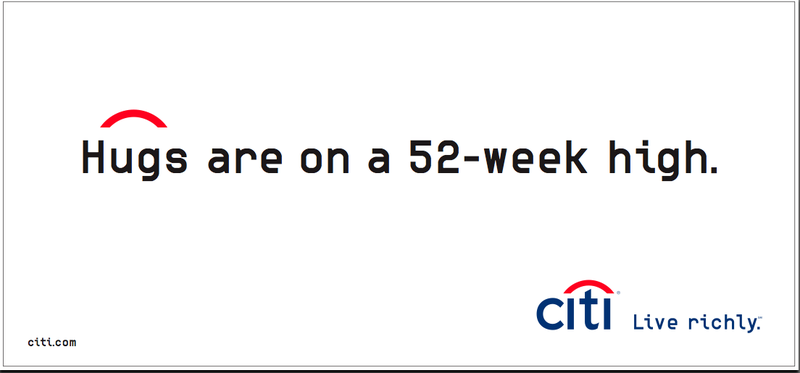 Still another spot showed up in the comics section, of all places. Alongside Peanuts and Doonesbury, the ad declared: "Sometimes wealth is having time to read these." – Brandweek, 2001
See more of Fallon’s Citi work here.
The opinions expressed in MortaBlog are not necessarily those of the author or anyone else at the Mortar for that matter. Just who owns them is kind of unclear really. If you do find someone who will own up to them for sure, let us know.