|
Author Archives: MortarMark
August 22nd, 2006

Recently, I was in a client meeting and was asked to come up with truly revolutionary examples of ad concepts done by B-to-B advertisers. As I researched notable business to business advertisers, very few stood out as truly exciting, let alone mention worthy.
This notion baffled me.
What is making a whole category of advertising so blasé?
Are our expectations of business brands just not up to the same standards as consumer brands? Why should loyalty to a B-to-B brand be based solely on its suite of product specs?
I took a look at some of the notable B2B brands like Cisco, IBM and Intel, and even these still play into many of the same issues. They fail to create an image or an experience with their brand outside of the product attributes and benefits. What does an IBM office look like vs. a Dell office? Is there a difference beyond configuration specifics? According to this the current view, the answer would be no.
At first look the problem seems to be two fold:
1. Business advertisers focus too much on their competitors and other B-to-B advertisers, creating an endless pool of variations of the same idea.
2. B2B companies don’t seek to enhance their understand of their customers beyond what they do for a living.
The first of the two shouldn’t be that surprising if anyone has ever done work in this space. Rarely do B2B marketers look outside the realm of business for inspiration. This is by far the ordinary way of doing things, using the logic “That companies sinking millions into a purchase, want to be reassured that they are spending money with a legitimate vendor.” Sure, putting together an ad together that feels like what competitors also might do, but haven’t, keeps you in consideration with the rest of the pack. However, it doesn’t make you stand out either. Yes, your product should be helping you in differentiation, but as technology becomes more accessible and more advanced those lines will soon be a close as a Coke and Pepsi taste test. The image of those brands is what keeps them from becoming a commodity. After all, who made the rule that road to legitimacy is spec-centric, chest-thumping product claims or slight humorous commentary of a process pain point? (See all ads by EMC, Microsoft, Dell, Novell, and the list goes on.) There is a great amount of learning that can be gained from looking outside the business category for inspiration.
This leads me to the second issue: B2B advertisers don’t really “know” their customers. People in their work environments are still people, they don’t lose human nature the moment they walk into the office. They still have feelings, drivers, emotions and desires just like they do when they buy shoes or cars or toothpaste. B-to-B ads focus on office decisions as purely rational. By the state of B2B advertising, you would think that we are speaking to a machine governed by purely logic. One could argue that because jobs, lives, brands and companies are at stake by these decisions, they are filled more so with the emotive aspects than that of consumer brands. The saying “It’s not personal, it’s just business” is about as far from the truth as we can get. There are key insights being ignored. What about emotional drivers? What about the societal values or the motives of the influencer? They exist in the workplace too.
— Posted by Nick.
Nick manages Communications Planning for Mortar. He can be reached at ntalbert@mortaragency.com
August 22nd, 2006

Mortarmark and his family are back after two fabulous weeks in Tuscany.
Funny thing about Italy. There is next to no advertising. Very little discussion about the web.
And everyone rides a Vespa — while smoking — and drinking a coffee.
All they do is eat, drink and make merry.
Interestingly though, the Italians gave birth to what was the first global brand: SPQR.
SPQR stands for the "Senate and the Republic of the People of Rome."
You can still find it etched into stone on memorials and buildings across Europe.
Saatchi & Saatchi CEO Kevin Roberts notes in his recent book "Lovemarks: the future beyond brands" SPQR was "one of the most feared and respected trademarks in the world." Four letters that told you the mighty Roman Empire was nearby.
"Over the centuries trade increasingly stretched past local boundaries and the importance of trademarks increased. Its fine to trust the local blacksmith. You could check out the forge, bite the metal, ask around. But the weird guy bringing iron implements from the next village? Not so easy. Trademarks moved up a notch from simple name tags to marks of trust and reliability" Roberts continues.
See the trip was not completely wasted.
July 27th, 2006
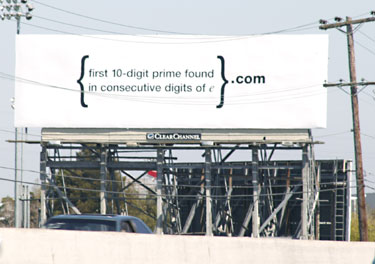
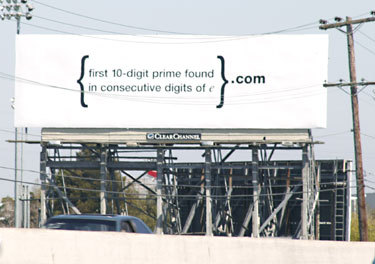 Mortar’s Communication Planner, Nick told me about this billboard for Google. Mortar’s Communication Planner, Nick told me about this billboard for Google.
Not content with straightforward help wanted ads, Google designed its own promotion for eggheads in Boston and Silicon Valley back in 2004.
Apparently, the solution to this puzzle is a URL address for an an even harder problem.
I’ll save you some hassle, the answer of course is 7427466391 (yeah, I looked it up, on Google of course).
Its nice to see an advertiser have the confidence to challenge its audience.
July 27th, 2006
Why is so much advertising so darn poor? Why do we insist on catering to the lowest common denominator?
Well if Professor James Flynn is right, our ads should actually be getting smarter because we — the global consumer — are way smarter than previous generations.
In fact, IQ scores have been rising for decades.
Despite conventional wisdom’s dire predictions of the steady, unrelenting dumbing down of society, we are better problem solvers now than our fathers, and their fathers before them.
"According to Flynn’s numbers, if someone testing in the top 18 percent
the year FDR was elected were to time-travel to the middle of the
Carter administration, he would score at the 50th percentile."
Writing in Wired, Steven Johnson the author of Everything Bad Is Good for You: How Today’s Popular Culture Is Actually Making Us Smarter points at our obsession with computer games as a cause to believe that the rise in IQ is accelerating:
"Over the last 50 years, we’ve had to cope with an explosion of
media, technologies, and interfaces, from the TV clicker to the World
Wide Web. And every new form of visual media – interactive visual media
in particular – poses an implicit challenge to our brains: We have to
work through the logic of the new interface, follow clues, sense
relationships… Perhaps unsurprisingly, these are the very skills that
(IQ) tests measure – you survey a field of visual icons and look
for unusual patterns."
"The best example of brain-boosting media may be videogames.
Mastering visual puzzles is the whole point of the exercise – whether
it’s the spatial geometry of Tetris, the engineering riddles of Myst, or the urban mapping of Grand Theft Auto."
"The ultimate test of the "cognitively demanding leisure" hypothesis
may come in the next few years, as the generation raised on hypertext
and massively complex game worlds starts taking adult IQ tests. This is
a generation of kids who, in many cases, learned to puzzle through the
visual patterns of graphic interfaces before they learned to read.
Their fundamental intellectual powers weren’t shaped only by coping
with words on a page. They acquired an intuitive understanding of
shapes and environments, all of them laced with patterns that can be
detected if you think hard enough. Their parents may have enhanced
their fluid intelligence by playing Tetris or learning the visual grammar of TV advertising. But that’s child’s play compared with Pokemon."
It’s time to sharpen up those ads, ladies and gentlemen.
July 27th, 2006
We spend what, $620 BN a year on marketing, so we should know how many messages Average Joe sees a day. Right? Well it seems we don’t.
Check out these estimates culled from Google Answers:
Estimate 1: 3,000 a day
“The average American is exposed to over 3000 ads every day. The ads increasingly encroach upon our public space — our schools, our public transportation, our buildings, and even our beaches" (a new technique enables the advertisers to stamp their ads onto the sand at beaches.)
http://www.bluejeanonline.com/features/features_archives/features0301b.html
Estimate 2: 1,600 per day.
“According to the Nielsen Report the average American home had the TV set on for about seven hours a day. The actual viewing was estimated at 4.5 daily hours per adult. To this had to be added radio, which offered 100 words per minute and was listened to an average of two hours a day, mainly in the car. An average daily newspaper offered 150,000 words and it was estimated to take between 18 and 49 minutes of daily reading time. While magazines were browsed over for about 6 to 30 minutes… Media exposure is cumulative… All in all, the average adult American uses 6.43 hours a day in media attention… Although in the US the average person is exposed to 1,600 advertising messages per day."
Emayzine Website
Estimate 3: That’s twaddle. It’s more like 150.
“The Guru has recently heard numbers cited between 3,000 and 20,000. These numbers are ludicrous. When challenged, those citing them will hedge and say they meant "informational messages" or some such and include product lables passed in a grocery store… When considering these silly numbers, it is best to stop and think: a person is usually only awake for about 1000 minutes per day. If they did nothing else but look at or listen to adverstising, it would take every minute of the day to generate 3000 exposures. A number aound 500 might be a reasonable extreme, again counting as exposure all the out-of-home media passed, and small space ads in newspapers and magazines,even thought there may be no notice taken at all… The Guru has seen estimates from a few hundred to many thousands. The Guru tends to go along with one of the best accepted estimates, that there are about 245 ad exposures daily, 108 from TV, 34 radio and 112 print. Others estimate 3000, 5000 or more. Even the 245 is "potential" and perhaps only half are real exposures. The higher estimates probably include all marketing exposure including being in the vicinity of product labels or actual products with trademarks visible, such as your car, computer, fax, phone, shirt, pencil, paper towel in the bathroom, etc. Just think, if we were really exposed to 3000 advertising messages per day, at an average of just 10 seconds apiece (accounting for radio :60’s and brief exposure to billboards), these exposures would consume 8.33 hours out of our 16 waking hours per day.”
The Advertising Media Inter Center Website
Um, no one knows for sure. But its probably a lot.
To read more on the topic:
http://answers.google.com/answers/threadview?id=56750
This industry scares me sometimes.
|