|
Author Archives: MortarMark
September 12th, 2006
 Early in the 20th Century, explorer Ernest Shackleton ran this ad: Early in the 20th Century, explorer Ernest Shackleton ran this ad:
"MEN WANTED FOR HAZARDOUS JOURNEY. SMALL WAGES, BITTER COLD, LONG MONTHS OF COMPLETE DARKNESS, CONSTANT DANGER, SAFE RETURN DOUBTFUL. HONOR AND RECOGNITION IN CASE OF SUCCESS."
Naturally, Hugh wanted to rewrite it: "’Men!?’ If the dummy had hired women, he probably wouldn’t have gotten lost in the first place. ."
Anyway, for the fourth time in three years, Mortar has moved. This is our story.
30 August, 2006
The journey begins. All are in good spirits, the provisions packed safely away. We look forward to adventure.
3 September, 2006
Crew safely ashore. New surroundings spare, but roomy. Sled dogs and Todd seem comfortable.
5 September, 2006
A polar bear has taken Tim. Apparently it offered him Cardinals tickets and a martini. Jeremy bludgeoned a walrus to death (for insulting the honor of the South); we shall make lamp oil from its blubber. Todd is making mai-tais. He is beginning to draw the ire of the crew.
9 September, 2006
We are now locked in a desperate struggle for warmth, reminiscent of Shackleton’s expedition to the South Pole. While we have not yet resorted to eating the sled dogs, a couple of them are giving us suspicious glances. As the crew fights for survival, Nick has mentioned a side business of storing furs, (Renata has volunteered to wear those furs,) and Suzanne is installing meathooks in the ceiling. Much like the hardy-yet-beautiful marsh fleawort (Senecio congestus), Todd continues to thrive in this cold, barren moonscape.
Pray for us.
10 September, 2006
Polar bear has returned Tim. He had a receipt, so we had to take him back. (Apparently there was a disagreement about the use of ellipsis.) Todd is attempting to give hula lessons on an ice floe he keeps referring to as “the Lido Deck.” Attendance is low.
12 September, 2006
As the remaining crewmembers huddle around the faint glow of the walrus-fat lamp, I notice their eyes flicking furtively towards Todd, who, clad in naught but a Hawaiian shirt and shorts, is humming contentedly and trying to get the crew to choose sides for volleyball. Suzanne’s hand slides stealthily towards the harpoon gun, and I am ashamed to note that no one, myself included, makes a move to stop her. Oh, the humanity.
Footnote: Send food parcels (and resumes if you’re game) to Mortar at our new digs: 25 Maiden Lane. Top floor. San Francisco, CA 94108.
September 7th, 2006
 Uncle Sam is ending its edgy, guerilla Verb campaign which was designed to get kids to work out and eat less junk. Uncle Sam is ending its edgy, guerilla Verb campaign which was designed to get kids to work out and eat less junk.
True to form, Congress is pulling the plug just as the program is demonstrating effectiveness. According to the medical journal Pediatrics, 9 and 10-year-old kids who had seen the Verb campaign reported one-third more physical activity during their free time than kids who hadn’t seen Verb. Among girls ages 9-13, the campaign boosted free-time physical activity by nearly 27%.
"Pediatricians and medical groups have sounded the alarm about the lack of activity and poor eating habits of America’s school children. About 13% of school children are overweight, according to the Surgeon General, who recommends children get at least 60 minutes of moderate physical activity a day.
Part of the problem with Verb is that many adults weren’t aware of it. The campaign was specifically targeted at 9-to-13-year-olds, and ads aired around shows like Nickelodeon’s "SpongeBob SquarePants." Surveys showed 70% to 80% of school kids were aware of the Verb campaign, but the effort didn’t generate the same excitement among adults.
"There is not a tremendous amount of adult awareness of Verb, but we haven’t targeted them," says Stella Kusner, account director on the Verb campaign for Frankel, a Chicago marketing agency. "But without fail, every time we go out to schools or camps the adults and teachers are amazed at the excitement and brand recognition that kids have with Verb."
Verb also got off to a rocky start after critics complained the government was focusing too much on exercise and instead should be trying to improve kids’ eating habits to counter the advertising muscle of the junk-food industry. But the CDC has said it didn’t want to lecture children about what not to do, and instead wanted to focus on a positive message that celebrated physical activity…
The Verb campaign also included the Yellow Ball, a symbol of kids playing in the sun. The campaign is in the midst of distributing 500,000 yellow balls at schools, camps and family events. Each six-inch rubber ball has a number. Kids are asked to play with the ball and then log on to verbnow.com, fill out a "blog" about how they played with it, and pass the ball on to a friend. The goal is to let kids track where their yellow ball went and who played with it.
Currently there are about 350,000 yellow balls in circulation and 12,600 kids have "blogged" their ball. As direct-marketing campaigns go, the 4% blog response rate of the Yellow Ball campaign is "pretty good," says Ms. Kusner…"
"If no one comes forward it will cease to exist as it is today," says Ms. Kusner. "The good news is we’ve got a lot of people interested in advancing physical activity for kids." –
Tara Parker-Pope in Tuesday’s Wall Street Journal
Man, that sounds familiar. Great idea. Easy to grasp. Well executed. Show’s success. But is killed because people outside the demo didn’t see the work.
Or is it just me?
September 3rd, 2006
The last line in Remax’s truly atrocious TV commercial claims that the growing real estate chain now sells more real estate than anyone.
Casting aside the fact that "more real estate" could refer to lot size, number of homes, or some other sleight of hand that only a statistician could love, Mortarmark doubts that few of us care.
Y’see we have done quite of bit of work in real estate. Most of it based, I am happy to say, on extensive interviews with consumers and real estate agents.
And you know what? Homebuyers and sellers by and large don’t give two hoots who sells the most homes; or who has the most agents; or how big their agent’s sign is or whether–shock, horror–their agent will find their dream home.
The focus group work we conducted with buyers and sellers in San Francisco’s ritzy Marin and Sonoma counties suggested quite the contrary.
Buyers complained that they found their "dream" homes themselves–and rarely did an agent identify the home they purchased. And buyers and sellers proved very capable of reading between the fine print in broker ads.
Perhaps, then it is surprising that these claims so often make up the bulk of real estate advertising.
The problem seems to be that real estate salespeople are essentially free agents. Unlike employees, most are independent contractors. Which means they can move their book of business for a rival brokerage anytime. No wonder most of the advertising plays to agent’s egos–reminding them they have made a great choice in affiliating with the #1 and, simulataneously intimidating rivals with the marketing ferocity of their sharp cross-town competitors.
In other words, most agency marketing resolutely ignores the consumer. Umm. Isn’t that meant to be bad?
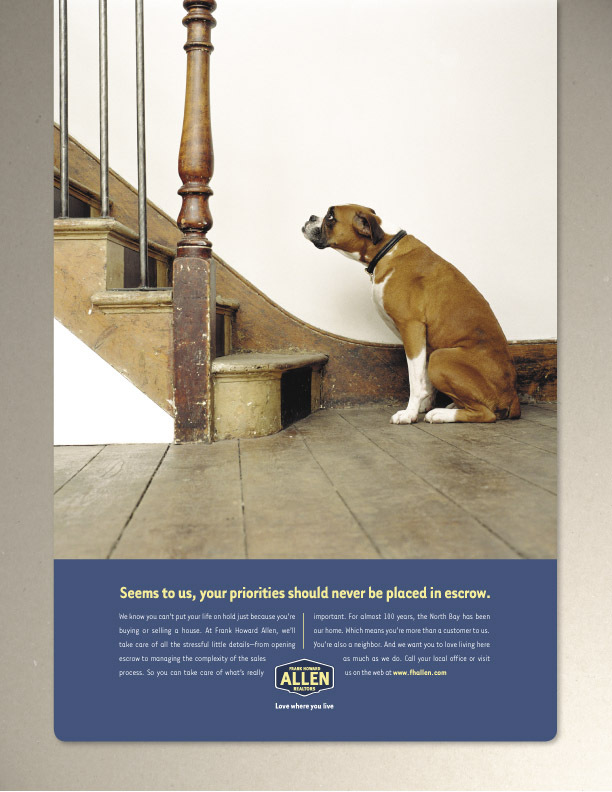
For an alternative approach, take a close look at the series of ads Mortar created for San Francisco realtors Frank Howard Allen. In particular you’ll notice two big differences.
1. Most of the action takes place inside the home, not curbside. We figured consumers care more about the potential of their new home rather than curb appeal. (Unlike agents who can trade bragging rights over addresses and lot size.)
2. We attempted to align our client with the emotional highs of of buying a home; with a firm nod towards the notion that buyers and sellers really don’t like their agent that much — they resent the sizable commissions for one thing — but nevertheless few would entertain selling their home themselves.

It is no wonder the traditional real estate companies are quaking in their boots over cut-price start-ups like Ziprealty. Like the US car-industry, the Real Estate industry has ignored its consumer for too long.
See more of the campaign here.
September 1st, 2006
Wall Street Journal reporter Lee Gomes estimates we have watched over 9,305 years of video on YouTube.com in Wednesday’s Journal (8.30.06).
"The video-sharing site doesn’t make public much of the information it has about itself… But it’s possible to piece together that sort of information by "scraping" the site… I did a scrape of YouTube a month ago and found there were 5.1 million videos. By Sunday, the end of another scrape, that number had grown by about 20% to 6.1 million. Because we know how many videos have been uploaded to the site, the length of each, and how many times it has been watched (total views were 1.73 billion as of Sunday) we can do a little multiplication to find out how much time has collectively been spent watching them….
Also, nearly 2,000 videos have "Zidane" in the title. Who at a desk anywhere on the planet didn’t watch at least one head-butt video in the days after French soccer star Zinedine Zidane’s meltdown in the World Cup final? For all the talk of the Internet fragmenting tastes and interests, YouTube is an example of the Web homogenizing experiences.
YouTube videos take up an estimated 45 terabytes of storage — about 5,000 home computers’ worth — and require several million dollars’ worth of bandwidth a month to transmit.
Those costs are one reason that some predict YouTube will collapse under the sheer weight of providing a haven for every teenager with a cellphone camera eager to be famous for 15 minutes of video."
It is a sobering thought that the bastion of viral marketing isn’t a runaway success. I thought that the hallmark of Web 2.0 was that Internet businesses were meant to run in the black from pretty much the get go?
September 1st, 2006
Notes from a first-time blogger.
June 8, 2006: Decide to blog.
June 9: Blog published. Wow. That was easy. Dawns on me that the future of web design –well engineering at least–is again up in the air.
June 12: Post first blogs. Two blogettes. Or is that blogiments? Receive first comment from Hugh, who sits across from me at Mortar. Discover Hugh also records his wife talking in her sleep and publishes the files on his own blog. Am struck by fact that I would never have known had I not blogged first. You can hear him shushing her in the recordings.
June 14: Janey tells me to post more pictures.
June 17: Discover other ad blogs. Decide Janey is right (isn’t she always). Steal pictures from other blogs. Am stricken with guilt until I realize that everyone else does that too. Nevertheless resolve to be original. Pictures added to blog. I go back and edit some material too.
June 18: Add first 100% original material: take photo of bus shelter outside my house and post it to the web. Feel great sense of accomplishment. PM Wife reads blog. Pronounces the whole thing silly and goes to bed. Threaten rest of team with death unless they add blog to sig line in emails.
June 19: Write first "in a series of" blog. Route blog for discussion. Milestone: 3 readers. Strongly suspect all 3 readers are me.
June 20: Conduct some Internet Voodoo. Hope my expertise in the dark arts will send me more blog traffic. Hit the blog a lot. Still at 3 visitors.
June 21: Nick the Planner wants in on the blog. Add Scooby Doo as a great dane. Worry that my Danish clients will disown me. Worry even more than it is now significant that my clients are Danish.
June 22: Decide that most ad blogs are misogynistic. Send biggest client to check out blog inadvertently. First thing she sees is a giant column sheathed in a pink condom. She bangs out "Mary has a Little Lamb" on the Sundown girls. Nice one.
June 22: Still no feedback on routed blog. Getting feedback blows.
June 22: Start diary of Blog. 9 readers now. Fairly sure its all colleagues.
June 26: Post answer to first brain teaser. No one wins the grand prize. Also post, then unpublish, a blog about click fraud. It marks the first blog apoproved by a client–and with the potential to piss off other clients. Post stays down while I sleep on the issue.
June 27: Post new brainteaser. Am flamed over the answer to the first one by a client. Post article about click fraud. Discover Coolhunter.net. Man is that site racy. Alexa ranks Mortablog at 856,796. Our two agency sites have Alexa ranks of 638,566 and 4,169,114. The Blog already gets more traffic than one of our sites that has been up for several years. Realize that each post is a separate traffic generator–as it gets indexed by search engines it draws a new audience. Never thought of it that way before. Keep thinking of Blogs like newspapers and Webpages, and imaging users coming in via the homepage. Funny how hard it is to shake off the blinkers. Another 100,000 and I can make the top 25 ad blogs on BeyondMadisonAvenue. Cool.
June 28: Alexa rank drops t0 1,053,000. Weird. We lose 50% of traffic overnight.
June 29 5pm: Alexa has us at 748,104 now.
July 10: 584,694 alexa. Added cheesey attribution to each original post. Let’s see what happens. Traffic today was: totale page views 993; 30.09 PVs a day.
Added three posts: shilled for 0b10 (colleagues shocked by the insensitivity of my headlines, client too has no sense of humor over post, decide I over did it, and water it down. Also posted notes on good briefs and a commentary on healthcare comms (sparked by our win of San Francisco’s St Mary’s Medical Center).
July 16: Alexa at 550,000 or so.
July 17 or so: Ask PR to proof the posts. As we’re publishing for the world to see it might as well be accurate.
July 24: Alexa at 458,914. 20% increase in traffic in just 8 days. Publish Nick’s B2B post. Nick tells me two of his friends read the blog. Its official. We have readers outside of Mortar.
August 18: disappear on vacation to Florence. Blog content suffers mightily. Who the hell blogs from Italy? Alexa rank remians unchanged. Well I guess that means we have not lost readers, and that most of the traffic is not me.
August 25: Receive two fresh submissions. One from Nick on the paucity of B2B advertising (inspired by our new client, Isilon’s kick-ass attitude to Storage and how they want to do things) and one from Will Kim, the Takewondo BlackBelt from Anaheim (resident AE). Will’s post focuses on using Improv theater troupes for guerilla marketing. Cool idea. Mortar moves to new digs.
September 1: Alexa at 402,908. Will still hasn’t posted his submission. Screenshot of current traffic:

The post about Crispin’s Backseat driver manual has been very popular.
|
 Early in the 20th Century, explorer Ernest Shackleton ran this ad:


