Category: Marketing Insights
July 27th, 2006

How many ads do we see every day?

We spend what, $620 BN a year on marketing, so we should know how many messages Average Joe sees a day. Right? Well it seems we don’t.

Check out these estimates culled from Google Answers:

Estimate 1: 3,000 a day

The average American is exposed to over 3000 ads every day. The ads increasingly encroach upon our public space — our schools, our public transportation, our buildings, and even our beaches" (a new technique enables the advertisers to stamp their ads onto the sand at beaches.)

http://www.bluejeanonline.com/features/features_archives/features0301b.html

Estimate 2: 1,600 per day.

According to the Nielsen Report the average American home had the TV set on for about seven hours a day. The actual viewing was estimated at 4.5 daily hours per adult. To this had to be added radio, which offered 100 words per minute and was listened to an average of two hours a day, mainly in the car. An average daily newspaper offered 150,000 words and it was estimated to take between 18 and 49 minutes of daily reading time. While magazines were browsed over for about 6 to 30 minutes… Media exposure is cumulative… All in all, the average adult American uses 6.43 hours a day in media attention… Although in the US the average person is exposed to 1,600 advertising messages per day."

Emayzine Website

Estimate 3: That’s twaddle. It’s more like 150.

The Guru has recently heard numbers cited between 3,000 and 20,000. These numbers are ludicrous. When challenged, those citing them will hedge and say they meant "informational messages" or some such and include product lables passed in a grocery store… When considering these silly numbers, it is best to stop and think: a person is usually only awake for about 1000 minutes per day. If they did nothing else but look at or listen to adverstising, it would take every minute of the day to generate 3000 exposures. A number aound 500 might be a reasonable extreme, again counting as exposure all the out-of-home media passed, and small space ads in newspapers and magazines,even thought there may be no notice taken at all… The Guru has seen estimates from a few hundred to many thousands. The Guru tends to go along with one of the best accepted estimates, that there are about 245 ad exposures daily, 108 from TV, 34 radio and 112 print. Others estimate 3000, 5000 or more. Even the 245 is "potential" and perhaps only half are real exposures. The higher estimates probably include all marketing exposure including being in the vicinity of product labels or actual products with trademarks visible, such as your car, computer, fax, phone, shirt, pencil, paper towel in the bathroom, etc. Just think, if we were really exposed to 3000 advertising messages per day, at an average of just 10 seconds apiece (accounting for radio :60’s and brief exposure to billboards), these exposures would consume 8.33 hours out of our 16 waking hours per day.”

The Advertising Media Inter Center Website

Um, no one knows for sure. But its probably a lot.

To read more on the topic:
http://answers.google.com/answers/threadview?id=56750

This industry scares me sometimes.

July 23rd, 2006

Think Different’s Triumph

Thinkdifferentbuilding
I found myself reviewing the copy for Apple’s famed "Think Different" campaign last week and was immediately struck by the fact that the usually hugely secretive Apple had announced its entire brand strategy in a campaign that debuted way back in 1997 four years before the launch of iPod in October 2001 (yes, it has been that long already).

Read it again:

"Here’s to the crazy ones.
The misfits. The rebels. The troublemakers.

The round pegs in the square holes. The ones who see things differently.
They’re not fond of rules.
And they have no respect for the status quo.

You can praise them, disagree with them, quote them, disbelieve them, glorify or vilify them.
About the only thing you can’t do is ignore them.
Because they change things.

They invent. They imagine. They heal.
They explore. They create. They inspire.
They push the human race forward.

Maybe they have to be crazy.
How else can you stare at an empty canvas and see a work of art?
Or sit in silence and hear a song that’s never been written?
Or gaze at a red planet and see a laboratory on wheels?
We make tools for these kinds of people. 
While some see them as the crazy ones, we see genius.

Because the people who are crazy enough to think they can change the world, are the ones who do."

Consider. With iTunes Apple solved the music industry’s distribution problems.  Apple followed it up by launching iPod into a market already dominated by mobile music players.

"Or sit in silence and hear a song that’s never been written?"

It was Apple that manufactured white computers and components while the rest of the industry distributed materials in two colors, black and vanilla.  It was Apple who pioneered the trademark white headphones creating the headphone generation.

It was Apple who launched the iPhoto interface.

"How else can you stare at an empty canvas and see a work of art? "

And it is Apple, thanks to its Unix-based operating system, that has the best opportunity to transform the PC into a lifestyle product in the same way Nike and Just Do It  have become far more than athletic wear.  

"Because the people who are crazy enough to think they can change the world, are the ones who do."

Apple’s revenues are up 48% this quarter. And to think Jobs laid out the strategy years ago. Right under the nose of Sony, Microsoft, and Hollywood.

If only they had been paying attention.

July 23rd, 2006

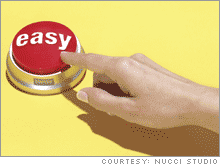
Customer hates EASY button. Customer hates EASY button.

Evilbutton
“It seems that advertising agencies think that they can cram any amount
of factitious crap down the gullible throats of the public. We need to
remind them we are a heck of a lot smarter, and can process far more
complex equations, just given half a chance. … As a business owner of
25 years, I found the mere notion of pushing a magic button which
solves all problems a slap in the face. Business is not easy. It takes
a great deal of blood, sweat, tears, skill and perseverance to make it
all happen. I couldn’t sit idly by when I saw this.”
— Crazy Al Cohen, who has published a PDF guide for hacking Staples’ EASY button into an "EVIL" button. (In an interesting twist, Cohen recorded his comments onto the EASY button’s hard drive via the built-in speaker which can be rewired to receive as well as transmit.)

Mind you he does have a point. I mean, why exactly is it more easy to get office supplies at Staples than any other big box retailer? It isn’t.

Despite the hype, it seems to me the EASY button campaign is an amazing accidental hit for the office products giant. And the attempts to link the button’s success back to an incredible consumer insight are the result of the reductive analysis that so often characterizes "brand analysis."

Every now and then an idea just works. It plugs right into our culture and takes off.

And the EASY button is a big hit for Staples. So big in fact that they have sold 300,000 shrink wrapped buttons already and the idea has been credited with helping drive Staples to the top of the office products hit parade.

Staples_easy03
To think the EASY button developed out of Staples’ drive to improve customers’ ability to find products in their stores (which small business owner has not spent hours hunting paperclips down featureless isles? I know I have).

"The five-year branding odyssey that began in 2001 has helped make $16.1
billion Staples the runaway leader in office retail. In 2005 its profit
was up 18 percent to $834 million."
Business 2.0.

But it is an unfortunate by-product of user generated content like Mr. Cohen’s mad rant (and amazingly detailed PDF), that no matter how effective an idea becomes, someone, somewhere, will be upset by it.

I’m reminded again of Bogusky’s comment about Subservient Chicken: "I like that they are talking about the work. If they aren’t talking, then your brand is dead."

July 17th, 2006

Boggle boggles the brain.

Boggle
Board game, Boggle, challenges the mind with these simple print executions.

Headline: noD’t ouy lkie amegs ttha kema oyu leef sartm?

Also seen on AdvertisingforPeanuts Blog.

June 26th, 2006

Symantec gets it backwards

Img_0131

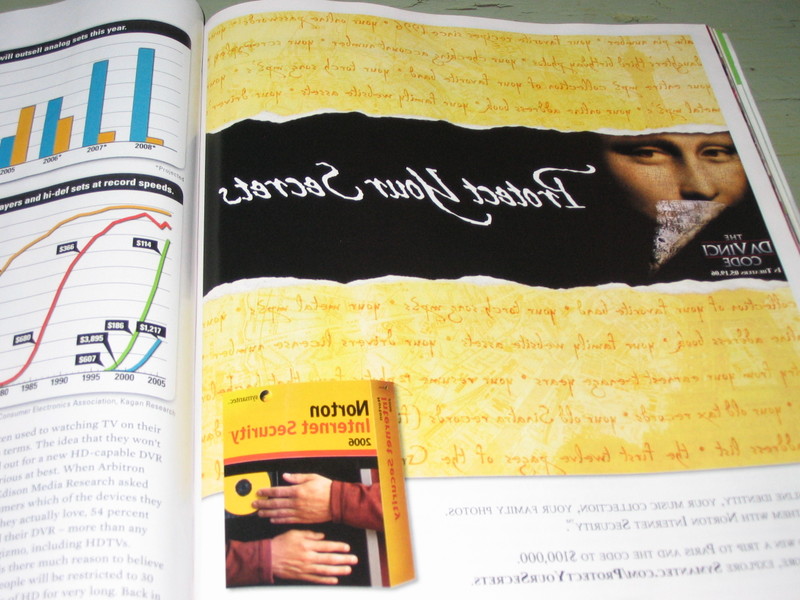
PC virus fighter Symantec takes a bold step in this month’s Wired with a promotion tied to the release of Columbia TriStar’s DaVinci Code movie.

Symantec’s ads are printed backwards, forcing readers to hunt down a mirror to decipher the message.

Few advertisers attempt to force readers to change their perspective. Stopping power rests instead upon design and reader interest. Marketers rarely require their audience to stop and think.

Not so in the UK, where marketing can be extremely oblique (I’m reminded of the UK’s Silk Cut cigarette ads). Aussie marketers in particular are notorious for running their ads upside down in the UK press. In the US, Citibank too are enjoying success with their thought-provoking outdoor campaign.

Frequent readers will be reminded by our brainteaser this week. (XI+I=X — the Fandango dollars remain unclaimed as of posting, gang).

According to neuroscientists at the University of Houston puzzle solvers experience a major change in bainwave patterns:

"Delta waves characterise such mental processes as memory; gamma waves are associated with co-ordinated mental activity. Both seem to be signatures of focused, but perhaps conventional, mental activity. The fact that both disappeared right before volunteers hit upon a creative solution suggests that the brain was escaping from conventional thought patterns" — Sharon Begley, Wall Street Journal, December 3, 2005.

Symantec’s twist has turned a ho-hum contest into something to gab about.

The DaVinci promotion links through to an $100,000 anagram contest

Media placement is designed to catch early adopters likely to be influential in the selection of personal and business purchase of virus protection solutions including Symantec’s leading seller, Norton AntiVirus.

The opinions expressed in  Mortablog  are not necessarily those of the author or anyone else at the Mortar
for that matter.  Just who owns them is kind of unclear really.  If you
do find someone who will own up to them for sure, let us know.